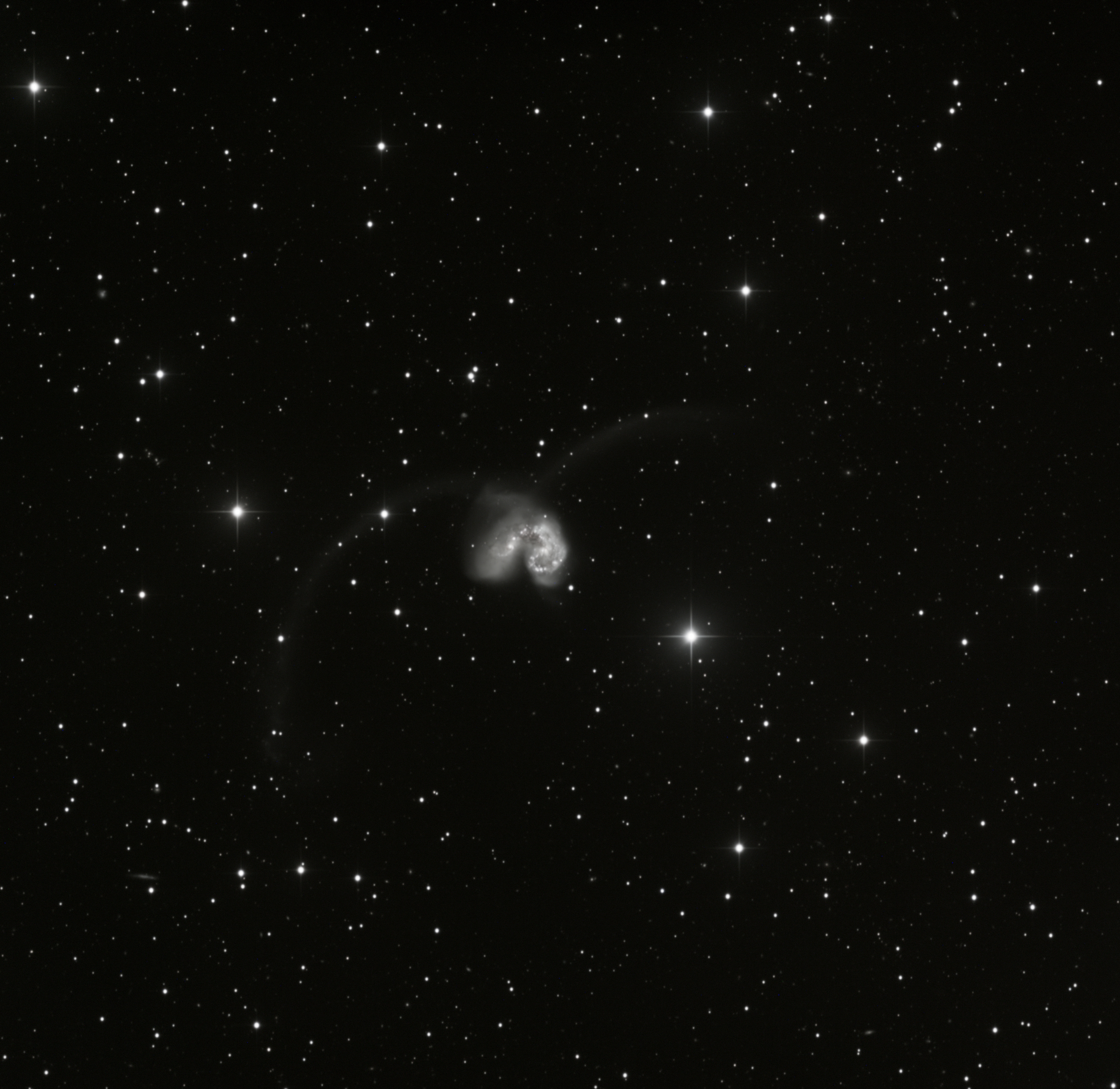
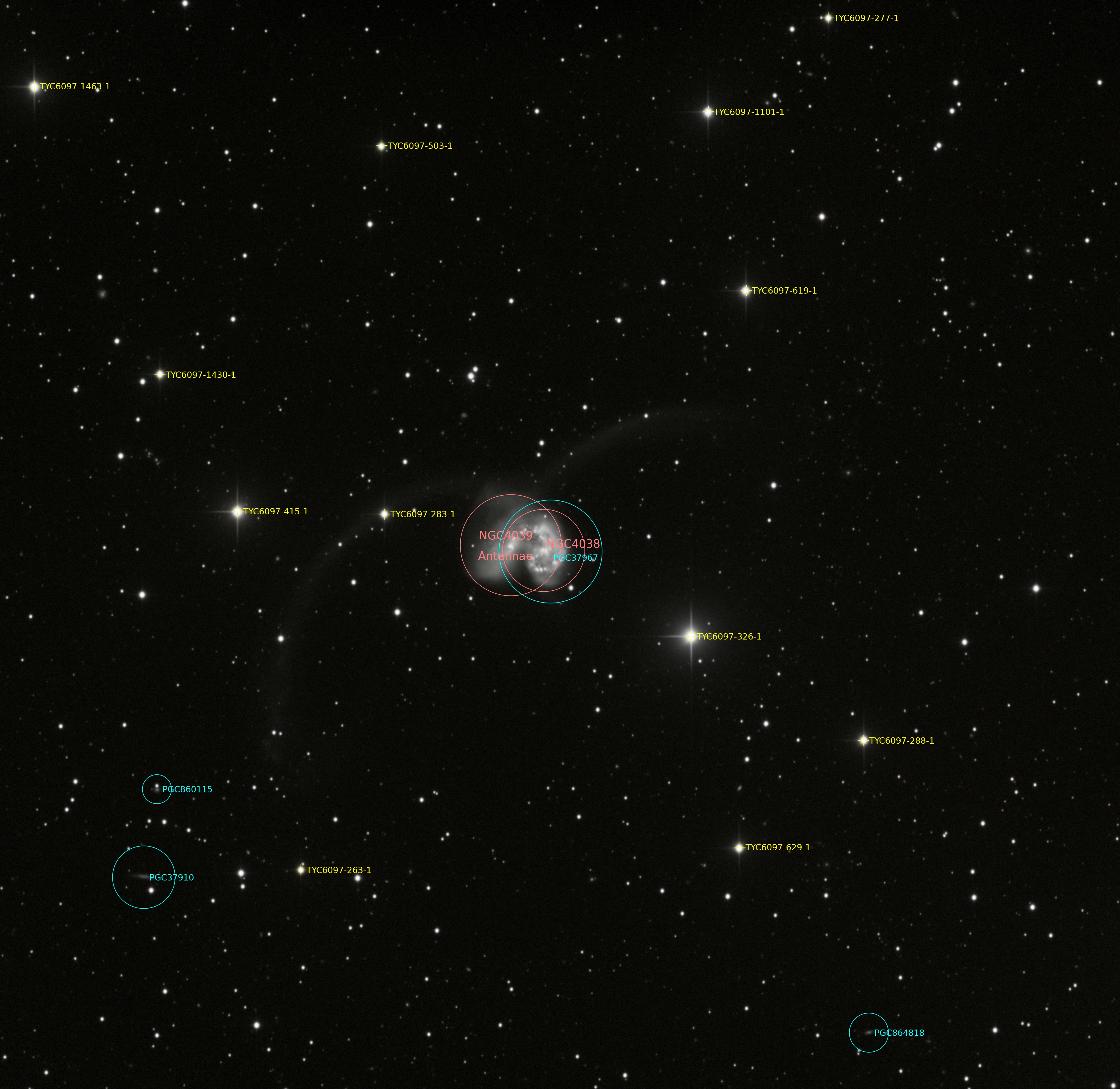
The Antennae Galaxies—NGC 4038 and NGC 4039, or Caldwell 60 and 61—are a pair of interacting galaxies in the constellation Corvus. William Herschel discovered them in 1785.
They are undergoing a starburst phase as colliding clouds of gas and dust, threaded by tangled magnetic fields, trigger rapid star formation.
The two long tails of ejected stars, gas and dust resemble an insect's antennae. Their nuclei are gradually joining to form one giant galaxy. Most galaxies probably experience at least one major collision; this is also the likely future of the Milky Way and Andromeda.
I captured fifty five-minute exposures in May 2022 using a remote-controlled telescope at Siding Spring Observatory through iTelescope.net.