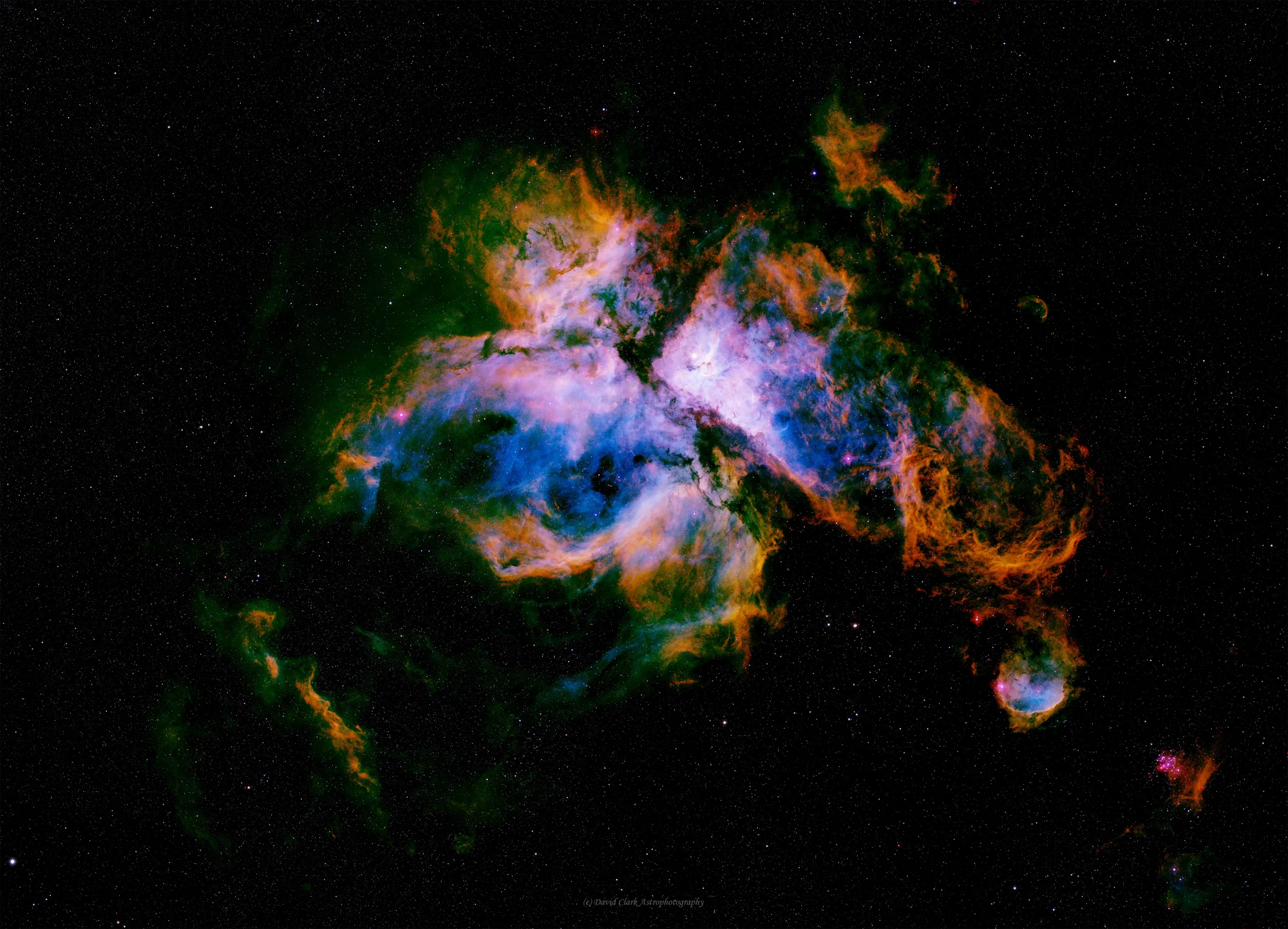
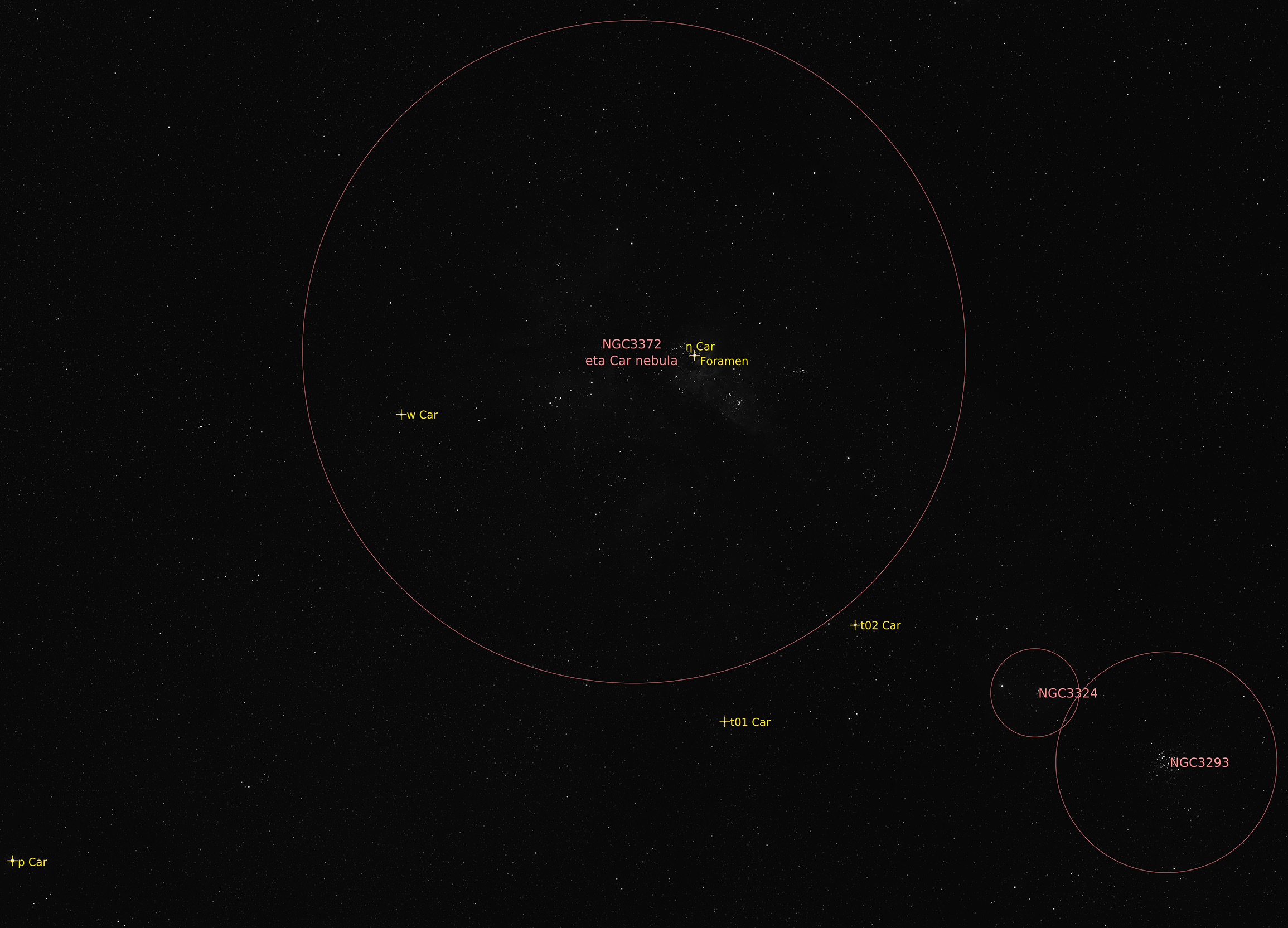
The Carina Nebula (NGC 3372) is a large, complex area of bright and dark nebulosity in the constellation Carina, approximately 7,500 light-years from Earth.
The central white-looking star is Eta Carinae. It shines around four million times more brightly than our Sun and is one of the most luminous stars in our galaxy. Its radiation illuminates the surrounding gas. The frame also includes the star clusters NGC 3324—around the emission nebula IC 2599 at lower right—and NGC 3293.
This enormous mosaic combines 16 frames in a 4 × 4 grid. It includes LRGB imaging and narrowband hydrogen-alpha, sulphur-II and oxygen-III data, with the narrowband channels combined in the Hubble palette.
The finished image contains 839 individual exposures and began with 15 GB of data gathered over eight nights in April 2020, using 60- and 180-second exposures. At 15,401 × 11,103 pixels, it contains more than 16 times as many pixels as a 4K display.
The equipment was my Sky-Watcher Esprit 120ED telescope and iOptron CEM60EC mount, operating from suburban Auckland, New Zealand.
Automated processing
The images were processed in PixInsight with custom scripts so that 16 panels across seven filters could be handled consistently. The complete processing run took about 18 hours on my workstation.
- Image selection and cropping
- Calibration, registration and integration
- Reference image creation and mosaic cropping
- Dynamic background extraction and star alignment
- Gradient Merge Mosaic across all seven filters
- TGV denoising
- LRGB and SHO combinations
- StarNet processing and PixelMath combination
- Final export