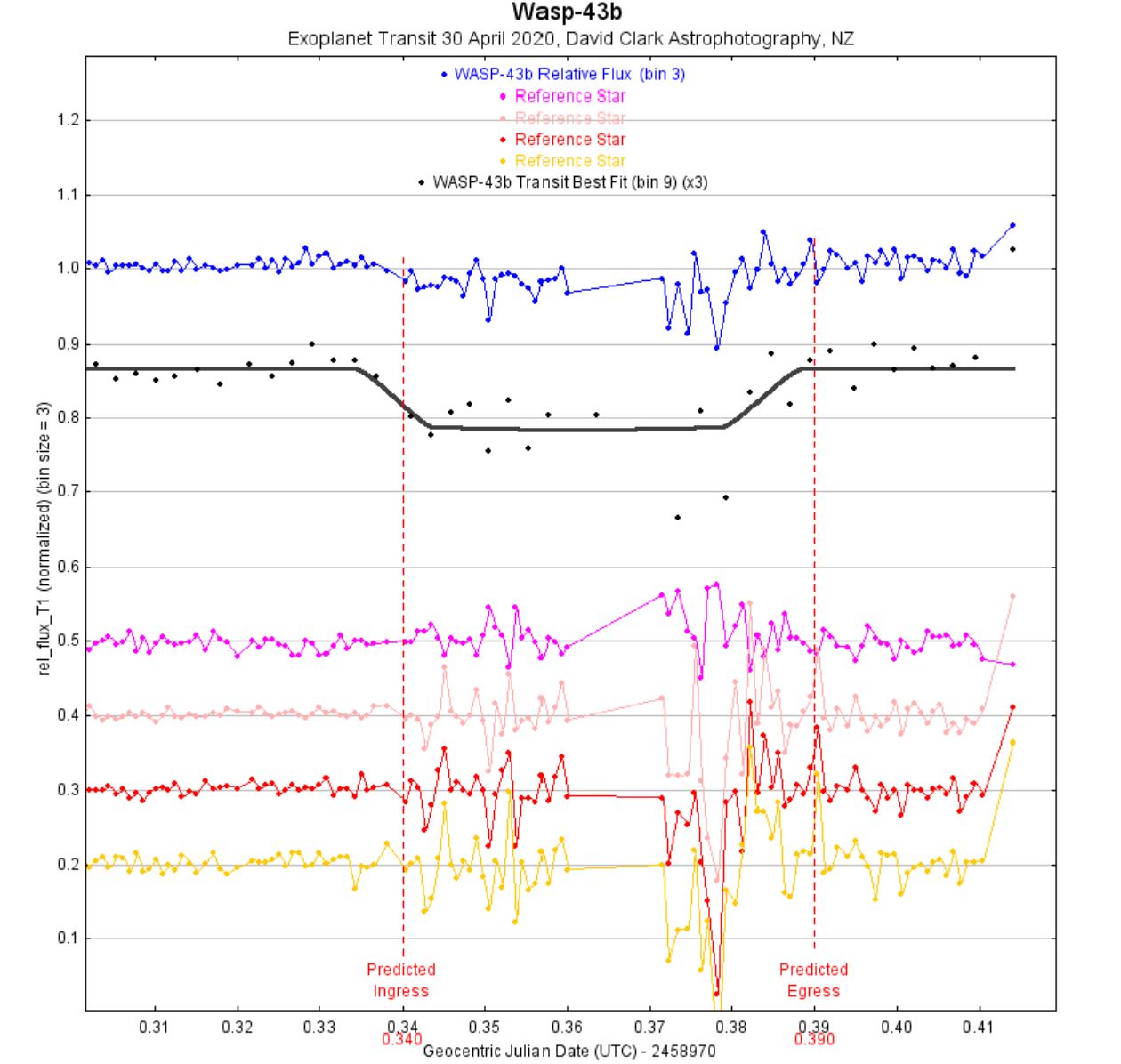
WASP-43 b is about the same diameter as Jupiter and orbits extremely close to its star, completing a revolution every 19 hours. From Earth, its path sometimes crosses the face of the magnitude 12.4 star and blocks about two percent of its light.
I observed a predicted transit on 30 April 2020 with my five-inch refractor from suburban Auckland, New Zealand.
The observation used differential photometry: repeated images of the target were compared with reference stars to reveal a very small change in brightness.
I captured 417 images of 17 seconds each. Conditions began well but deteriorated over the three-hour session as high cloud moved through; nine frames were rejected. The remaining images were calibrated and registered in PixInsight, then measured in AstroImageJ.
The resulting light curve clearly shows the expected 0.025-magnitude dip. It is remarkable that amateur equipment can detect a planet orbiting another star.